lundi 4 mai 2020

IN THE ERA OF THE BIG TIMEQUAKE. April 24, 12:30pm

Beginning a little weekly of probably failed attempts to plant from seeds and reusing fresh earth coming on organic lettuces or other vegetables delivered by Misfits. These weekly deliveries of organic unfit vegetables began thanks Barbara Kirshenblatt-Gimblett 's advise and Eléonore 's initiative. I have always loved planting and growing plants. I had a balcony in Paris (voice over imitating Meryl Streep : " I had a farm in Africa"). I don't have an outside space in Bay Ridge. Here you see me extract the seeds of a non organic strawberry with tweezers. It would be fun to document a pair of my dyspraxia doing the filling of the egg shell with the little quantity of earth grated from the lettuce roots... But it's a quandary to do my Jacques Tati thing and film myself in the same time. Having Nurith Aviv as a cameraman could help. As you may understand I'm desperate for growing plants, berries, citruses, herbs. I will go for almost any seed falling under my hand. Red peppers have so many seeds and I have a few ones, but very little fresh earth.
In fact it is not that much a practical exercise. It's why being dyspraxic is not an issue. It is a theurgical action of kavone. Yes, those who didn't read until this place will not be able to share the core of the idea. In this era of Timequake, where past and present reflect in the miror of our houses' remoteness each little practical act to feed and clean and organize life takes the dimension of a mitsve, is sacralized by the imperative of Life preserving. We live the same way we cook preserves or we bake bread or kukhn. We look for seeds to grow in an eggshell or a nutshell, we transplant the arborescence of trees into minuscule formates, as the Japanese taught us with the slow, sophisticated and beautiful art of cutting and growing and maintaining bonzais. And when we open Skype to learn from our grand-children, the levinassian face of the other somehow inverses itself creating for us and them the most sacred moment of teaching and learning through a media détourné and redirected toward an intention that was probably not involved in the technological tool it's inventors conceived. Who would guess - some around me did (mentioning my visionary friend Michel Grosman) - that grand-parents was a category soon to be eliminated by the market driven Assassins that have taken power here and there, together with the poor sent back to work in the full swing of a pandemic without protection. We have entered a new era of history which main feature may be the disruption of transmission. We Jews are maybe a little bit less threatened because of the strength of our traditions, religious and secular, but if we let the Hubrixes of the planet have the last word, we may be flooded by the Timequake.
This little text was conceived and written while preparing a vegetable soup.
Naomi Seidman, Michael Gottsegen, Joëlle Hansel, David Mazower, Vicki Brower, Roy Greenwald, Charles Yisroel, Rachel Biale, David Biale, .

lundi 6 avril 2020

A CHUNK OF CHEESE AFTER THE TIMEQUAKE

A Chunk of Mildewy Cheese after the Timequake


I almost never remember my dreams. My seven years plus two of psychoanalyze have relied on very few epic night dreams, a lot of minuscule fragments and my rich fantasy, colored and often disconnected with reality imagination. One might say very narrow underground passages to my sewers with heavy gates that close with a spectral metallic echo (oh, the image comes straight from a version of Les Misérables for the French Television I saw when I was around ten years old).

So this morning I woke up to an epic one that connects my mentors, my Yiddish and musical peeps, my family and the present cataclysmic situation.

We were a ballet company on tour in a country of Eastern or more precisely Central Europe. You know these places where Zev Feldman, Michael Alpert and sometimes Zisl have a lot of artistic attachements and friends and where they bring their productions and/or transpose  their creations. The ballet was led and choreographed by Abigail Ilan, the wife of my soulmate little cousin Yishai Ilan.
I see her showing us motions in front of a building like the ones hidden in the courts of Vilner Rudnicki Street. When I checked Rudnicki Street on the web, I first found that: YIVO building ….  : https://ingeveb.org/blog/vilner-yidishistn-in-their-natural-habitat#&gid=null&pid=2

So Eastern, Central, we are somewhere aheym, home.
After a while there is a shortage of food – you have to know that I am (also) the French translator of Peter Garnsey, Famine and Food Supply in the Graeco-Roman World. Responses to Risk and Crisis. One of us, the administrator of the company maybe, Barbara Kirshenblatt-Gimblett, manages to unearth a chunk of rotten, mildewy, somehow spoiled cheese, not really blue cheese, but more like a hard cheese that was going amok. It must have been a pretty big one. With this cheese she fed the company, insisting each dancer had enough every day to protect its immune system and stay strong enough to perform. And so we did under her firm guidance. Yes it was guidance and dance related, although the only dance mouvements that I saw were the ones of Abigail. But fermentation, nurturing, cultivation, transformation of food, by brewing and stirring, saltpetre and leavenous action were the physical and metaphoric subject of my dream.
A wonder that Trimalcion in person was absent of the next scene – now that I think about it, it pretty much resembled the reunion scene right after the earthquake, in the steam bath, of “Le Satyricon"  (that I may have seen a dozen of times in my post 68 youth. Here the Art Gallery) 

Except that, instead of sitting around the swimming pool, the little crowd of dancers were lying on individual beds cramped against each other (the beds) like in the children’s room when a bunch of grandchildren arrives for vacation and grand-parents have to accommodate all the gremlins. Almost everybody was sleeping, Rokhl Bas Cyprus that I recognized at her yoga outfit, Steven Weintraub, and quite awake and making funny faces Shane Baker, just after I have followed his Mina Bern evocation. That makes sense. 
Sleeping in the YIVO building under the nurturing surveillance of Barbara with a bunch of friendly colleagues and futures (I wrote uftuers) after the time quake makes me feel confident in the uftuers and the future. Yiddish will live, dance will guidance, paideia and learning and teaching will develop and we will continue to conjugue verbs.


jeudi 12 mars 2020

ESTHER DEVINT REINE ET ROSE GARDA SON SECRET

Comment Esther devint reine et comment Rose garda son secret


    J’ai habituellement beaucoup à dire – trop diront certains – à l’occasion des anniversaires de mes parents. Mais en méditant ce Pourim à la signification de cette fête, et bien je me retrouve non pas muette, mais avec une montagne de questions et d’idées qui prendraient beaucoup de temps à être déroulées comme un collier de Shnirele perele.
Purim occupe une étrange place dans le calendrier juif où elle semble émerger d’une autre civilisation (de plusieurs autres en fait, la perse et la grecque) et converger avec tous les carnavals de la planète. Si on ne conférait pas à Purim des sens allégoriques, mystiques ou même ésotériques, les anniversaires qui dans notre famille s’attachent à Taanit Ester pour Mic et Shushan Purim pour maman, relèveraient du folklore.
Rose debout à côté de son père Baruch Portnoi. 


    Pour les origines de la Megilat Esther, l’article de Wiki dit à peu près tout ce qu'il faut savoir. Une origine qui peut remonter au sillage de la destruction du Premier Temple et la première déportation des Juifs à Babylone, mais peut aussi être aussi plus récente et dater de la période hellénistique (même période que le texte de Daniel), mais ne peut pas être postérieure à la première traduction grecque qui date d’environ -70.

    Le roi pourrait être Xerxes Ier ou Ataxerxes, mais dans un cas ou dans l’autre, les sources perses ne concordent ni avec les événements ni avec les coutumes politiques ou même matrimoniales décrites dans le rouleau d’Esther. Nous sommes donc assez clairement devant un morceau de fiction, peut-être même l’ancêtre de la nouvelle ou du court roman, styles littéraires qui devaient bientôt se développer dans l’Egypte ptolémaïque à l’époque hellénistique.

    Dans ces conditions, la probabilité d’un roman à clé et donc d’une intention mystique et ésotérique du texte se consolide. Il est tentant, pour moi qui les ai à une époque étudiés, de faire des parallèles avec les récits qui associent Proserpine, la fille de Déméter, à Hadès (Pluton). Dans la mythologie grecque, Perséphone (en grec ancien Περσεφόνη / Persephónê, chez Homère et Pamphos d'Athènes Περσεφόνεια / Persephóneia) est une des principales divinités chthoniennes, fille de Zeus et de Déméter et aussi épouse d'Hadès. Elle est d'abord connue sous le simple nom de Coré (Κόρη / Kórê, « la jeune fille »), par opposition à Déméter, « la mère » (ἡ Μήτηρ / hê Mếtêr). Déesse du monde souterrain (les Enfers), elle est également associée au retour de la végétation lors du printemps, car chaque année elle revient six mois sur Terre puis six mois dans le royaume souterrain avec Hadès, notamment dans les mystères d'Éleusis. On remarquera le thème du changement de nom, Coré – tiens une jeune fille (Hadassa en Esther), le cycle des saisons et la coïncidence de ce mois d’Adar avec les profondeurs de l’hiver qui précède de peu la renaissance du printemps. Et enfin un culte mystique de Perséphone et de sa mère Déméter à Éleusis (c’était un peu Lourdes pour les Grecs anciens).

    Comme vous le savez… Je ne suis pas rabbin, mais depuis des années, je me suis exercée à scruter des images, des photos de jeunes filles, et ce qui frappe bien souvent sur ces photographies, celles notamment prises avant la guerre où la coutume était de dignifier la posture par une certaine gravité, c’est un air mystérieux qui plane sur ces beaux visages. Peu de photographies modernes montrent des jeunes filles qui présentent ces visages de princesses au seuil de leur entrée dans le monde, voire de déesses. Photos de classe ou portraits individuels, les photos de cette époque incarnent au mieux ce caractère caché de l’histoire et ici, de notre histoire.

    Il me semble que maman, dont nous avons la chance d’avoir des photographies depuis l’âge de dix ans – ce n est pas donné à tout le monde – ne s’est jamais départie de cet air de gravité énigmatique. Sur toute les photos que nous avons d'elle, cette expression de très légère absence, tel un voile, est palpable. Elle est là, mais elle est aussi dans un ailleurs qui nous est inaccessible. Ses traits qu'elle tient davantage de son père (avec une forte ressemblance avec son frère) changent peu au long de sa vie, ses coiffures bien sûr au fil des modes, son port de tête pas du tout, et son visage traverse le temps sans grande altération de son expression et de son être au monde. Comme toute femme qui a traversé bien des épreuves et vu des choses qu’elle aurait préféré ignorer, comme toute personne s’étant plusieurs fois arrachée à son ancrage pour sauver sa vie, sa famille, sa liberté, elle portait en elle bien des secrets. Sa plus grande victoire de Suse a été de nous préserver de ses pires cauchemars en laissant planer le mystère des ombres qui la hantaient. Rose garde son énigme et avec le temps, celle-ci s'épaissit forcément, quand bien même le monde d'où elle vient nous est mieux connu aujourd'hui qu'hier.
  
PS: Mon histoire alternative de Shushan Purim : C'est un roi un peu primaire mais qui a un grand sens politique qui fait d'Esther une reine. Attendez. Il ne va pas jusqu'à prendre la défense des Juifs de son royaume, le souverain, non, non, c'est un souverain qui veille à ne pas perdre sa base électorale. Au contraire, il met tout le monde à égalité en fournissant à TOUS – même les profs et les nourrissons – la possibilité de se défendre (les fabricants d'armes se frottent la bedaine). Il permet juste aux Juifs de se défendre le jour où il a été planifié de les assaillir... Ce qui permet d'admirer les qualités militaires des Juifs, après avoir été émerveillés par les qualités morales, spirituelles et érotiques de leurs femmes, qui sont toutes des reines Esther en puissance. Mais allez savoir si des femmes armées ne leur mettaient pas la pâté à Suse aux voyous de Aman .

dimanche 8 mars 2020

NEVER BECOME RICH


“Never become rich” 
Isabelle Rozenbaumas – YIVO March 2


Microphone check: "Papa, do you hear me"?

Thank you Barbara Kirshenblatt-Gimblett, Samuel Kassow for shedding light on my father’s book. Always learning from you. A great yeshkoyekh to Jane Tuszinski and Alex Weiser for organizing this event, and Sandra Chiritescu for running the Power point and your precious help. 
I want to praise the translator Jonathan Yank Layton. For my Meyerowitz family – sponsoring the event in memory of their father Max, I have a love without borders and beyond words, going back to our parents affection. But how can I thank enough my amazing daughter Eléonore Biezunski for the artistic direction of the event? 

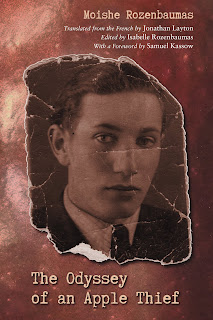
I would like to express my gratitude to Syracuse University Press and in particular to Ken Frieden for publishing this young worker’s memoir. Being published by a a university press would have been for Moishe a motive for pride — and I will not keep it a secret – for me as well. I also want thank YIVO, my spiritual home in the world, and Jonathan Brent, for hosting this event.


Most of us have had or have a father and a mother.

Not all of us though had a father who used to say “Never become rich”. Did I take this prescription too seriously? Did I interpret a zifts, a sigh, as a political statement? Growing up in my parent’s house, I have been educated as if poverty and hardship were knowledge, almost science. What should I do with that today?
Apprenticeship may be a key word to understanding my father’s life. To which we can add necessity, hard work, trial, poverty and – thanks gotenyu in himl – resourcefulness.
My father Moishe became an apprentice at age 10. Born on May Day 1922, he liked to joke about the proletarian fate promised to him at birth.
My father didn’t begin his life as an orem kind – a poor child, nor as an abandoned one. But both of these experiences were in store for him. When his own father left the country after bankruptcy in the wake of the Great Depression, Moishe became der breyt-geber, the bread-winner of the family. His mother gave birth to a fourth boy that my grand-father would never get to know. And while Moishe struggled for subsistance and became a qualified tailor, cataclysmic historical events were in the offing. 
From his fidgety childhood in Jewish Lithuania, where stealing apples from church orchards was his favorite escapade, Moishe does not want to paint an idealized portrait. As we follow his steps in the kheyder, among his family and playmates, as an apprentice, and as a laboring teenager, we get a precise and moving portrait of the lives of working-class Jewish youth in Telz/Telšiai, a religious town celebrated for its yeshiva. 

When the war broke out, Moishe fled Lithuania alone. The very few moments in the book where he evokes the last time he saw his mother and brothers, and his return to Telz after the war are full of emotional self-restraint. He followed a voice that drove him onto the roads, heading away from the bombings. Where was this voice coming from ? In another presentation about his mother’s part in Moishe’s specific brand of intelligence, I linked Ulysses with the Greek feminine figure of Metis. Fraught experiences took him across Russia and among the refugees wandering through Central Asia, where he ends up starved and enslaved in an Uzbek kolkhoz. Recovering from typhus, he enlists in the 16th Lithuanian division of the Soviet Army, rapidly joining a reconnaissance unit where his ingenuity in defying danger is a key to his unlikely survival.

Entendement

Somewhere in his early writing Moishe ponders on what it is to understand – using the French word “entendement". Moishe had an acute awareness that a narrative could grow from arranging and reconstructing facts from hearsay. In his foreword he mentions how crucial it was for him to write from his “personal” and unique perspective, from what he saw and what he was a direct witness to, especially as he took up his pen decades after the events. Nevertheless, his post-war education permeates beneath the relatively simple surface of chronological construction there is always a concern for context. When useful for his intended reader (typically a child, a grand-child or a great grand-child) Moishe supplies essential geographical and cultural notions, to which I added to meet the requirements of this University Press edition. 
Most importantly the ongoing conversation between tradition and politics was the fabric of his thought. How come? And why was that?
Moishe's curiosity extended to every realm of intellect and culture. His taste for “The Complete Works of so an so…”  was no doubt shaped by the formal Marxist-Leninist method of study. For young party cadres, schools were opened everywhere in the Soviet Union, especially in the newly established Socialist Republics like Lithuania. His description of the economic chaos{p. 138-139} and of the hypocrisy of the Soviet system (mainly the Party-unions mechanism) owes a lot to the literacy and knowledge he gathered in these schools combined with his power of meticulous observation, not to mention a devastating sense of derision, an eye for absurdity… à la Boulgakov {p.133}

“We were taught basic subjects, like Russian, some Lithuanian, and last but not least Marxism-Leninism and party history. Russian geography and the geography of the Eastern countries was one of the fundamental subjects.We studied and studied Marx’s Capital over and over again, as if it were the Bible; the twenty volumes of Lenin’s Complete Works; and Stalin’s twelve tomes. Among those graduates who finished these courses at the party school, a few were chosen to attend further classes. They were designated to benefit, again for four years, from the evening courses at the Marxist-Leninist University that was in every Soviet republic. Once again I had the unbelievable luck of being selected. In spite of the propaganda, the lies, and the ideology, the eight years spent in the midst of this indoctrination brought me knowledge of economics, politics, and even philosophy. Naturally, only materialist philosophers were studied, and not all of them, either. All in all, having access to an education, however partial and biased, finding myself with people who knew about things of which I was ignorant, discussing with them subjects that had been unthinkable beforehand, led me to think for myself, to pose new questions, and, finally, to a fundamental self-reassessment.” (p. 137)


But his own thirst for knowledge was motivated even more by his desire to make sense of his life's tribulations, to understand his ordeals in time of war, and his survival as his family was engulfed in the hurbn. If only through the materialist critiques of it, metaphysics was floating in the air. So it shouldn’t be surprising that in his later life, having journeyed on his odyssey and traversed through philosophy, he returned to the religion of his pious mother. 
Compassion, empathy, humanity

Never did Moishe forget the long years providing for his family while learning a trade. He always emphasized these formative years when he observed the balebos, the street, the town, the Jewish society from the bottom up. He never forgot to speak of the most vulnerable, the poorest of the poor, the bearers of the heavy burden of long hours of work, the paupers at the border of misery and even of sanity{p.24-25}.
Almost every episode of the book involves these heartfelt notations about the condition of the downtrodden, be it about skating or swimming with kids, eating on Shabbes {p.10}, the picturesque beauty of the town and its people. He describes the butchers and other shopkeepers and their system of credit, the hovels where the indigent lived, the religiosity of the Jewish population {p.24-25}, the bustle of the market square and the price of the herring. 
He also evokes the personal dignity of Mere-Khaye, his mother, when their impoverished family couldn’t afford the most necessary products and she had to make the decision to place Moishe into an apprenticeship. Through the book the social question is interwoven with… almost everything, from relations with girls to religion and of course politics.
My father never lost his sense of humanity. My cousin Cyril Meyerowitz who had a warm relationship with Moishe writes to me: 
"His ability to develop relationships and attachments with individuals was fundamental to his survival. He writes appreciatively that his travel partner had skills he did not have and that those skills were essential to his survival. [One wonders how much his own survival instinct, his pragmatism or his relational skills played a part.] He doesn’t write about what attributes he brought to that survival fight that were equally important to his partner and their collective survival."
The only war action he describes in graphic detail is going to bring back a wounded camarade across the enemy line, covered by a diversion of fire. He utters his muffled pain when he finally brought back the young man on his shoulders, dead, leaving behind a trail of blood on the white snow. The interdependence and solidarity of elite reconnaissance unit members was more than iron “discipline, obedience and responsibility” instilled by the army. For Moishe, it was very much the image of what a mentsh ought to do in a given situation.

A sensitive reader and intellectual

Already in Vilna after the war, my father had read the Russian classics, Dostoïevski, Gogol, Tolstoï, Pushkin, Tourgeniev, and also the naturalist literature in translation, Dickens, Zola, Balzac. He appreciated the roman picaresque of Cervantes and Dante’s complex vision of the world, while philosophy appealed very much to him. Most of all he liked historical frescoes and Alexandre Dumas complete works occupied a respectable place in his small library. As soon as he discovered it, he developed a real love for classical music. I cannot get rid of a few recorded audio-cassette cards of concerts and operas, where he has documented systematically the names of the composer, the conductor, the singers, the pieces played, and every detail a cataloguer classifying for archival purpose would record. 

My mother Rosa, Michel Biezunski, and Moishe reading some text in our Paris apartment May 1996
Years passed and I became close to and then assistant to my teacher, the French historian Pierre Vidal-Naquet, books circulated between our houses. My father read everything systematically and with delight. From social sciences, history of Judaism to the literature of Mitel Europa, and from psychoanalyses to history of science, Moishe read, absorbed and discussed everything with me. 
He was a genuine literature lover. Knowing how much he had appreciated the Complete Works of Kafka, I was still surprised how much he was hooked on Leo Perutz, and later on the cryptic novels of Bruno Shulz. At the end of his life when he was fighting with his language skills and Alzheimers, I read him poetry in Yiddish, Sutzkever's Grin Akvarium and its French translation by Batia Baum. Later, when he was in a nursing home and things were getting worse, he never lost his sense of irony and laughed with pleasure at Der Kleyner Prints, the Yiddish translation by Sholem Lerman. Especially at the prejudice of the scientific community that needs the Turkish astronomer to come back in occidental guise to record his discovery of the Asteroid B612. Since then, I call the Yiddish planet, Astero-yid B612.


I may have been the main beneficiary of Moishe's conversational skills in discussing an array of historical, literary, philosophical and political questions. Our brains and hearts seem to have been in tune. In the words of Barbara Kirshenblatt-Gimblett, I may have been the perfect daughter for the perfect father. Perhaps I had arrived at exactly the right moment, in a mazldiker sho, after the “Doctors' Plot” and a fortnight after Staline’s death, precisely when Moishe started having doubts about his ideal. But clearly he had nourished doubts about the entire system much earlier… because as he writes: 
"The risks of the war had been enough for me, and I came to reject this life, both dishonest and perilous, even though the whole society was gangrenous. As for the workers, they could be arrested for a trifle, being imprisoned for seven years just for being found leaving the factory with a spool of thread. A cadre occupying a high-level post could juggle truckloads without getting caught, because the system was corrupt and rotten. I had decided to become a mentsh again, an upright, no-tricks man, an honest worker who earned his living with his hands."{p.153}

A talent for love

When my father told us "Never become rich", he meant: "Don't do like my father who abandoned me/us to run after fortune, don't turn away your face from me as soon as you achieve opulence (I never did), don't abandon me in my old age because your human values were overwhelmed by materialist concerns". Papa's politics, always consistent, were that a part of the population cannot be "abandoned" on the side of the road. From the infinite source of love he received from his mother whose authority he never questioned, he poured onto us an endless amount of this intangible legacy. Like our Jewish god, this love is impalpable and invisible, you can only feel it. He wanted us and our offspring to be aware that THAT was our most precious possession and that in fact we possess nothing but that love and fondamental sense of humanity and we can bequeath nothing else that is indestructible. 
And as Sacha, mayn bruderl, der eyntsiker mit vemen ikh hob zikh geteylt a tate-mame, says in French: ""notre richesse n'est pas matérielle""
Bien vu, well said bruderl.
My brother Sacha made this photo... From right to left: Moishe, his grand-daughter Mélinée, Sharon Meyerowitz Kreitzer, Shuli Meyerowitz, Micheline my sister-in-law, myself (laughing), Cyril Meyerowitz, Rose my mother, Mel Kreitzer.
Although out of focus, this photo shows how loving and full heartedly caring was my father. 


mercredi 1 janvier 2020

METIS IN THE MIROR OF MERE-KHAYE


In the Mirror of Mere-Khaye
Presentation at YIDDISH NEW YORK
Isabelle Rozenbaumas
December 26th 2019 

This book is the outcome of what was a long process of writings, in the  plural. Moishe took up his pen in 1994. The text that I read for the first time in the summer of 1997, in Berkeley, was written in Yiddish.  It already had – except for chapter divisions – the shape of the text published in French by La Cause des Livres and in English by SUP. 


Waiting for me to translate it in French, my father wrote his own French translation from Yiddish in a language that I call tate-loshn and that I discussed in another presentation, years ago. The title was “Double fidelity and double betrayal”. Only after me being unsatisfied with my first thirty (too elegant) pages of translation did we engage in a tate-daughter translation of this double canonic original… into French.
Around fifteen years later, it was translated by Jonathan Layton, well before we knew it was to be published by Syracuse University Press. My father passed away in November 2016. I was lucky that he had the systematic idea to record his complete manuscript on four 90 minutes cassettes which are now archived and digitized and consultable at the YIVO sound archives thanks to his granddaughter, Eléonore Biezunski. As my father was not anymore at my side, only after quite a long process of checking against these recordings was I assured that the French version had nothing left out of the nuances the voice of my father indicates (like the his allusive dray pintelekh…) It obliged me to track back all we added together in the French version and make sure nothing was lost, and that the English version was faithful to all the canonic originals. Jonathan Layton had then won his place in oylem aba, in the world to come.
What I had recognized from the first was the thought, the substantiality and seriousness of a story told by a man who had taken on history with a capital H. We will come back later to the acute awareness without self-conceit of Moishe and where that all came from. He was aware to have been through cataclysmic events of mythological dimension.
The multilingual gilgul of Moishe's text reflects the place and function Yiddish has had in our family, not only in the French relatively stable context of our immigrant life (and in my case a second American context) but also the central place of Yiddish in the multilingual context of interwar Lithuania, during the vicissitudes of the war itself and under the Soviet regime. 

VAYBTAYTSH
The linguistic history of my family belies the general statement that women were less educated than men and therefore used to access the biblical and liturgical text in Yiddish translation, in vaybtaytsh. 
My grand-mother Mere-Khaye grew up in the shtetl of Gorzd (Lit. Gargždai) – one of the first Jewish settlement in Lithuania. In this minuscule shtetl that Sholem Aleichem would characterized as “big as a yawn”, there was an Esperanto club that is documented with a photograph in he Washington's Holocaust Museum. I didn’t know this photograph when I chose to include in my film a Bielorussian heroe, Alexander Austraukh, explaining that compared to the “mathematical miracle” of Esperanto Yiddish was “a feminine miracle”.
Mere-Khaye was known as a pious women, praying in Hebrew and probably writing it, able to read and speak German (Gordz was in the beeline of the Prussian border), conversing in Lithuanian with her neighbors, and of course speaking, reading and surely writing our vernacular Yiddish. I don’t exactly know how and when she was schooled and educated. She was born around 1895. These facts I know not only from my father but also from my mother Rosa Portnoi who knew her from her Shul in Telz where she used to attend on Shabbes and which Mere-Khaye attended once my father’s family moved after his mother had married my grandfather Yitskhak Rozenbaum, and their home in Endreyave had burned down.
  It seems that languages where a woman’s skill in this vinkl world, this corner of the world, because my mother Rosa Portnoi was able to speak seven languages. A fierce student at the Telzer Gymnasium Yavne where the language of instruction was Hebrew, she was fluent in this language (yes, with all the dikduk) and in Lithuanian (yes with all the complicated declensions), she lamented that she had missed English because Latin replaced it in the curriculum of the school (I found out in the archives it was a correct information, and that it happened in 1931, two years before my mother entered the gymnasium). Rosa also learned and was able to converse in German, adopted Russian during and after the war by way of sovietization, and made a systematic effort to acquire a correct French after immigrating to the country in 1957. And have I mentioned that – once I began to study it – she never let me make a mistake in Yiddish without interrupting to correct me. The most epic demonstration of her language skills occurred when an Italian friend, a mathematician from Bari, invited at my parents' table heard her recite – she had an uncommon memory – verses in Latin and exclaimed: “But it's Catullus!” How did the erotic poet arrive in my mother’s kosher mouth in the very tsnyesdiker  gymnasium Yavne ? That is a mystery that I have never clarified.
This heymish multilingual climate is the reason I did not want to establish a glossary and included only a few footnotes when the context or some apposition or commentary didn’t shed enough light on the meaning of a Yiddish or Russian expression. The intertextuality of our multilingual jokes and incessant commentary is the colorful fabric of the book, as it was of our lives.


UNDER MANY STARS AND THE PROTECTION OF METIS
[[This colorful fabric brings me to a book written about Ulysses and its Odyssey, by an Italian author, Pietro Citati, La mente colorata, the colored mind.]]
Moishe’s memories were full of very small details where the figure of his mother plays a soothing role but also a very channeling one. Calm, discipline, anticipation and spirituality were her North Star and defining qualities. As a child, Moishe was hyper active and fidgety and a little master of many tricks and inventions. It is not only because of his wanderings at the beginning of the war or his journey home through the battlefields that this book was titled Odyssey of an Apple Thief. As we understand from his narrative full of humour, being born on May 1st was foundational to a life of labour and craft. Unlike his older brother Yosef, he wasn’t built for long hours of zitsfleysh, what you are sitting on when you dive into studying our sacred books. I will not comment on his first romance with a red hair and freckled meydele in his first heyder at Endreyave, a little girl who was a reflection of his own red hair complexion. He didn’t persist as a Narcisse. 
The description of his early schooling in a Telzer heyder introduces us to the dark frightening figure of a melamed, a brutal teacher of another era with a primitive pedagogy: “What could a child do, faced with this man straight out of mythology?” What he could do? He could and did … throw a candle in the brick stove, creating a cloud that forced an evacuation of the room. [Athena did no less when casting a midst to protect Ulysses when landing in his Phocean island.]  Moishe also understood how electricity worked and caused short circuits, with the same outcome. He disrupted and thwarted the rules and stopped the ruler of the locally abusive Zeus. When denounced by a mother whose child was treated unfairly by Moishe on the football field, Mere-Khaye would say: “Meyshele, all this fighting is non-sense. You have to live in peace with your fellows.” And Moishe promised. 
I will not dwell upon the lovely and detailed description of Jewish life in a typical – maybe not so – shtetl in Lithuania, as I will not enter upon the details of my father’s reaction to my grandfather’s misconduct and later departure from the country toward greener pastures when Moishe was not yet ten years old, and his mother was pregnant with a fourth child, a boy that my grandfather would never get to know. 
Apprenticeship to a photographer, again an abusive balebos, the hardships of a young laborer working late into the night, his solitude as the child who was “chosen" by his mother to bring money into the home: all had a decisive influence on how he dealt with the world in peacetime and in the flames of war. At one point – by this time he had already become an experienced tailor – Moishe discusses the condition of happiness for a working class teenager, breyt-geber, the bred-winner of his family, abandoned by the father. It is at the same time heartening and heartbreaking. [[And it opens of course on the subject of relation with Jewish and non Jewish partners, in his case, girls.]]

My late teacher, the historian Pierre Vidal-Naquet, was a major scholar of the Ancient Greek world, of Greek tragedy, and in the field of historiography. As his loyal student, assistant and disciple, I have to introduce you here to a colorful Hellenistic feminine and maternal figure, the Greek Metis, goddess and concept for a specific form of ‘cunning  intelligence’  as evoked  in Marcel Detienne  and Jean-Pierre Vernant’s  opus ‘Cunning Intelligence in Greek Culture and Society’. In their words: 

Metis is a type of intelligence and thought, a way of knowing; it implies a complex but very coherent body of mental attitudes and intellectual behavior which combine flair, wisdom, forethought, subtlety of mind, deception,  resourcefulness, vigilance, opportunism, various skills  and  experience  acquired  over the years. It  applies  to  situations which are shifting, disconcerting and ambiguous, which do not lend themselves to precise measurement, exact calculation or rigorous logic (p. 3). 

I will not follow all the way Amber Jacobs' post-structuralist neo-feminist analyzes based on Luce Iragaray, Helene Cixous and Judith Buttler.  But I agree when she noticed that Detienne and Vernant “demonstrate that this form of cunning intelligence was very much alive and an important aspect of Greek  culture and  society  –  but  has  been  systematically  marginalized  and overlooked by modern Greek/Classics scholars and philosophers because of the dominant legacy of  the  Platonic  metaphysical  tradition  that condemned  and  banished  metis  as  an unreliable corrupter of the Truth. Vernant  and  Detienne  present  us  with  the  essential features of metis, its  modus operandi, its terminology and associations. [[They trace the  concept  back  to  its  origins in  the fields of hunting and fishing. ]] Metis, the ‘many faceted’ intelligence, belongs to the duplicitous world of traps and devices: the knot, the net, the weave, the rope, the mesh, the bait, the noose and the snare. [[Vernant  and  Detienne  identify  the  fox  and  the  octopus  as  creatures  most  richly endowed  with  metis  and  use  them  as  models  to  describe  the  full  scope  of  cunning intelligence that extends far beyond the world of fishing and hunting – and can be found in allusions and associations across ten centuries that separate Homer from Oppian.]] Metis is an intelligence always ‘ready to pounce’ an action based upon a ‘many faceted  knowledge’ using trick, deceit and vigilance. Metis  is  an  action generated by "weighty condensed thought informed by experience"; it seems impulsive but is not at all. Metis ‘foresees the unforeseeable’ {{?}}– seizes opportunity and is forever on the alert. Metis is ‘multiple, many colored and shifting’ –  it  belongs  to ‘the  world of appearance and becoming’ – polymorphous, pliable,  fluid – it  can never be  pinned down or seized.  [[Like  the  octopus  ‘it  assumes  every  form  without  being  imprisoned  in  any’ .]]  Metis  functions  through  inversion and reversal; it pertains to  all  that is pliable, slippery and twisted,  oblique, elusive and ambiguous. 
And if I tell you that, in Hesiode’s theogony Zeus absorbed Metis, his first wife, "for fear that she might bring forth something stronger than his thunderbolt”, while she was already pregnant with Athena, will it make clear that what I have in mind, is the non-gendered intelligence and power that results from this absorption? Non-gendered because bi-gendered. And if I tell you that a specific episode where my father at age six or seven – burning  with fever – was able to convince a storekeeper to sell him a pair of skates with metallic blades, and the way Mere-Khaye dealt with her disobedient child and the not very scrupulous store keeper, has prepared my father to survive in a reconnaissance – intelligence – unit, will you believe me? This very sophisticated intelligence unit turnover ten times its personnel. Moishe was able to join its ranks, totally illegally, after being wounded, by letting the hierarchy of a less prestigious reconnaissance unit where he was serving believe that he had been recruited by the new one, and the new one believe that he was sent.

I could go all the way through the book to analyze exile and war peregrinations, the walking, the biking, the boating, the walking again with a bundle on the shoulder, selling the watch and selling the bike, being robbed and being rescued with a piece of bread and a glass of milk by the generous Russian peasants. I could pursue with digging holes in the snow, building igloos, hiding in trees all nights long, observing the positions of the enemy, trying to bring back a wounded camarade across the lines. I could recall the after war swimming between two waters in the cogs of the Soviet regime, being a gifted student and propagandist of Marxist-Leninist school and a cadre of the fabric union, facing corruption, getting hands dirty in the smartest and most human way, saving his dignity and escaping again using stratagems and the interstices of the power iron control over the camarades of the Party. Big Brother was watching you.

In each of this occurrence we would find Métis at work: 
  1. Using Dolos, cunning intelligence, over strength, deceit if necessary. Polytropos, he carries thousand tricks and pranks. But he also has the technical gift of construction and conception. After all Ulysses is the one who built the Trojan horse. Polymechanos. 
  2. Sharp-eyed, being always on alert, patience and wit, are the recipe for leadership. From the aptitude to control your own impulsiveness, and even wilderness, depends your success. How do you lead a team of schoolmates in the orchard of the Catholic priests seminar and withdraw without losses? There were no military grades in Soviet army reconnaissance units. How are you prepared to you renounce hierarchy when solidarity is a life and death issue ? How do you organize raids on the Uzbeks food reserves in an hospital where you recover from typhus?
  3. Poikilometes, our Ulysses is variegated, multicolored, ever changing, adapting to unstable situations of hardship, oppression and unpredictable choc on the front lines which he crisscrosses. 
  4. But also charming and engaging. How do you convince a mother with seven daughters – the most daunting exercice – that you are a decent man when you are able to drink your one liter dose of Vodka every day and you demonstrate it in front of the whole mishpokhe?
Finally we will not go through the all book and I will let you the pleasure to play this polymetis treasure hunt across the pages of Odyssey of an Apple Thief. I can only tell you that you will never be disappointed.

Reading Jonathan Layton

THE BI-GENDERED RUSSIAN DOLL
What happened, after all, in this translation adventure, to her father’s daughter?  It is not insignificant to write as a translator, let us say a particular translator, the memoirs of one’s author, of the author of one’s days. Double betrayal, double fidelity, these are the lines of force of our relation to history, to our history. Why double? Why not make it simpler?  Because our history is not only a continuum of events bound together by chains of causality.  It is also the result of the rigorous and patient work of elaborations, of reconstructions, of representations. Nourished by family speech, leaning on my father’s narrative, plunged into my own internal questions, I put my steps in my father’s ones when I made a film with Michel Grosman:  a reflection on Yiddish, its flamboyance, its denial, its destructions, its persistence.  
But what happened really in the chain of transmission. I could have been satisfied to identify the lisping Litvak Yiddish of my father with Moishe rabeinu’s stammering and draw a parallel between their leadership qualities. I could have been simply a good and loyal Jewish daughter. And not adventure on the ancient Greek field of battle. But something was missing of the variegated multitude of our people. I tend to think that – not unlike the generations of Titans, Gods and semi-humans of Hesiod’s Theogony – we are the vehicle for the generations that precede us and follow us. When we engage in producing a new human being we are at least 32 (let’s speak only of the four last generations) 32 in the bed or … the test tube. 
Through my film, through my father’s book, I was reaching out to Mere-Khaye, murdered only 12 years before I was born. Her thoughtful and clever, quiet and wise education made my life and that of my brother possible. Raising her sons, enduring her husband’s philandering and departure, asking Moishe to undertake his escape without her has given life to me. This disloyal Olympian grandfather who undertook his own self salvaging Odyssey, he amassed hundreds of Yiddish books in Paris, that were lost by his third family.
Darning, patching, mending this history allowed me to take up the thread that bound me, not in the abstract to earlier generations, but in a very concrete way to Mere-Haye in particular, to Tsivie and Aaron in particular, to Yitshak, to Haye-Dvoyre, to Hassye-Rivke and to Baruch in particular, so that in the end they inhabit me without haunting me. We are the polychromatic iridescent fabric of past generations.